
Articles

Office workers attending an AI literacy training session with an EU regulatory framework displayed on screen

The Weight of AI Literacy in the EU AI Act: What Is Expected from Companies — and What Can They Actually Deliver?

When the EU AI Act entered into force in August 2024, most compliance attention immediately gravitated toward its high-risk provisions: the risk classifications, the conformity assessments, the technical documentation requirements. Article 4, tucked near the beginning of the regulation, attracted far less scrutiny. It is, after all, just one sentence long. That sentence, however, has […]


The Weight of AI Literacy in the EU AI Act: What Is Expected from Companies — and What Can They Actually Deliver? Read More »

AI governance concept with glowing neural network node surrounded by EU-style regulatory stars and silhouettes of SMEs and public institutions

The EU AI Act’s Innovation Chapter: Sandboxes, SMEs, and the Limits of Open Source

Chapter VI of the EU AI Act is where Brussels attempts something unusual for a regulatory text — it tries to be helpful. What it reveals about the law’s architecture, its blind spots, and its real-world friction is worth examining carefully. The EU AI Act is, by design, a demanding piece of legislation. It classifies

The EU AI Act’s Innovation Chapter: Sandboxes, SMEs, and the Limits of Open Source Read More »

Illustration of EU AI Act implementation in Germany showing compliance checklist, Bundesnetzagentur supervision, and AI governance for SMEs.

AI Act Implementation in Germany: What SMEs Need to Do in 2026 and 2027

Updated May 2026 to reflect the Digital Omnibus agreement of 7 May 2026, which pushes the AI Act high-risk enforcement deadline from August 2026 to December 2027. The EU AI Act is already partially in force across the European Union — including in Germany. While the regulation applies directly in all EU member states, each

AI Act Implementation in Germany: What SMEs Need to Do in 2026 and 2027 Read More »

Infographic showing the EU AI Act implementation timeline from 2024 to 2027 with key milestones including the entry into force, prohibited AI bans in 2025, main obligations in 2026, and final high-risk compliance deadlines in 2027

EU AI Act Implementation Timeline: What Applies in 2024, 2025, 2026 and 2027

Updated May 2026 to reflect the Digital Omnibus agreement of 7 May 2026, which pushes the AI Act high-risk enforcement deadline from August 2026 to December 2027. The EU Artificial Intelligence Act introduces the world’s first comprehensive regulatory framework for artificial intelligence. But unlike many laws that apply immediately, the AI Act follows a phased

EU AI Act Implementation Timeline: What Applies in 2024, 2025, 2026 and 2027 Read More »

Illustration of EU AI Act compliance checklist for SMEs showing business professionals reviewing AI governance requirements, checklist documents, and an AI chip symbol against a European Union regulatory technology background.

AI Act Compliance Checklist for SMEs

A Practical Guide for Companies Using AI in Europe The EU AI Act introduces the world’s first comprehensive legal framework governing artificial intelligence. While the regulation is often discussed in the context of large technology companies, small and medium-sized enterprises (SMEs) will also face concrete obligations when they develop, deploy, or use AI systems. For

AI Act Compliance Checklist for SMEs Read More »

ai act high risk

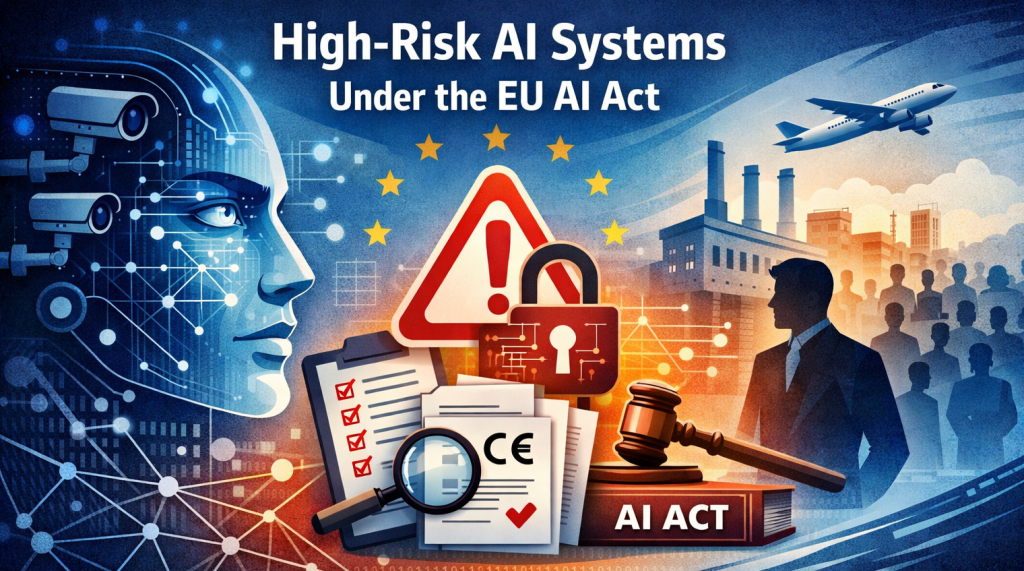
High-Risk AI Systems Under the EU AI Act

Artificial intelligence systems that fall into the high-risk category are subject to the most comprehensive regulatory obligations under the EU AI Act. For companies operating in Europe, identifying whether an AI system qualifies as high-risk is a critical first step. High-risk classification triggers a set of legal requirements relating to documentation, risk management, transparency and

High-Risk AI Systems Under the EU AI Act Read More »

EU AI Act risk categories diagram

EU AI Act Risk Categories Explained

The AI Act risk categories are the foundation of the EU Artificial Intelligence Act.Every AI system used or deployed in the European Union falls into one of four regulatory risk levels, which determine the compliance obligations that companies must follow. Understanding these categories is the first step for any organization that develops, deploys, or integrates

EU AI Act Risk Categories Explained Read More »

eu ai act explained european ai regulation

The EU AI Act Explained: Structure, Risk Categories and Scope

Updated May 2026 to reflect the Digital Omnibus agreement of 7 May 2026, which pushes the AI Act high-risk enforcement deadline from August 2026 to December 2027. Artificial intelligence is rapidly transforming industries, from logistics and finance to healthcare and manufacturing. To address the risks and opportunities created by these technologies, the European Union has

The EU AI Act Explained: Structure, Risk Categories and Scope Read More »