Analysis

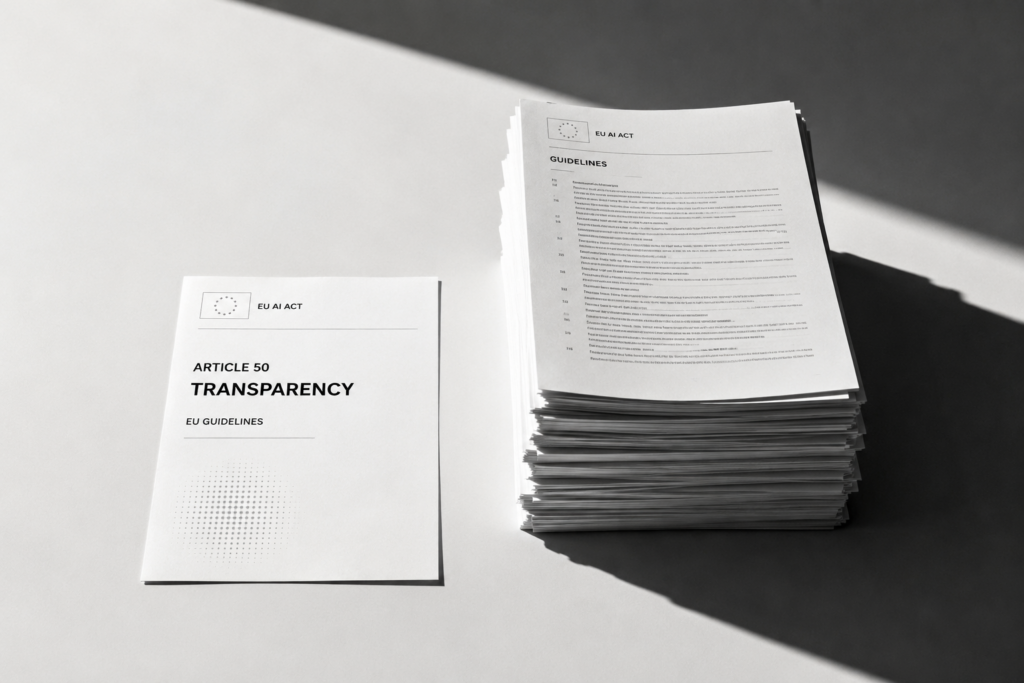
A single sheet of paper beside a thick stack of documents, illustrating the gap between Article 50 of the EU AI Act and its forty-page implementation guidelines

Article 50 AI Act Compliance: Forty Pages of Guidelines, One Page of Law, and the Gap Between Them

Article 50 of the EU AI Act is one page and seven paragraphs. The Commission’s draft guidelines to implement it — published on 8 May 2026 for stakeholder consultation until 3 June — are forty pages. That gap is the compliance problem in one number. This piece works through what the forty pages actually add, […]

Article 50 AI Act Compliance: Forty Pages of Guidelines, One Page of Law, and the Gap Between Them Read More »

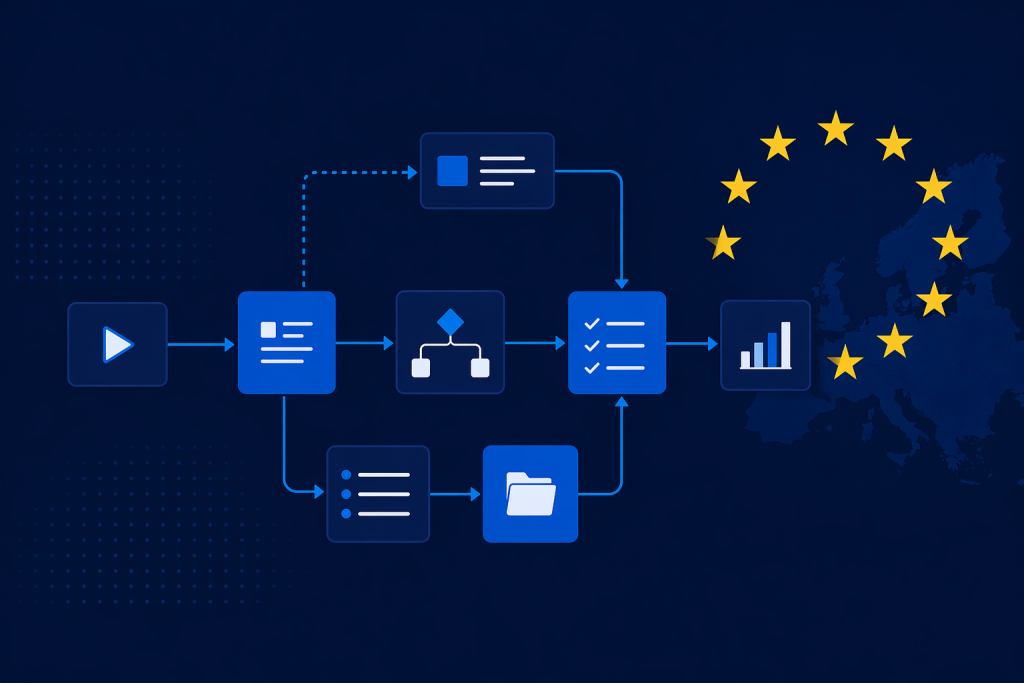
Diagram showing an AI agent workflow with interconnected task nodes and branching execution paths, alongside the EU flag and European map, illustrating the regulatory scope of the EU AI Act over autonomous AI systems.

AI Agents and the EU AI Act: Already in Scope, Still Poorly Understood

The question of whether AI agents fall under the EU AI Act has generated more confusion than it deserves. The short answer is yes — in most cases they do, and not because the Act was amended or extended to cover them, but because Article 3 was written broadly enough to capture them from the

AI Agents and the EU AI Act: Already in Scope, Still Poorly Understood Read More »

A human hand interacts with a translucent AI interface displaying candidate ranking scores and star ratings, connected by glowing lines to compliance document icons, set against a dark office background — illustrating the intersection of algorithmic HR decision-making and EU AI Act documentation obligations.

The EU AI Act and HR: Why Human Resources Is Among the First Functions in the Enforcement Crosshairs

Most HR teams are not thinking about the EU AI Act. They should be. The regulation does not require a company to build AI. It does not require a dedicated AI department. It does not distinguish between a company that develops its own algorithms and one that subscribes to an off-the-shelf ATS. What it requires

The EU AI Act and HR: Why Human Resources Is Among the First Functions in the Enforcement Crosshairs Read More »

Diagram illustrating the diverging compliance cost paths for EU AI Act providers versus deployers among SMEs

EU AI Act Compliance Costs for SMEs: What You Will Pay in 2026 — and Every Year After

The EU AI Act’s core obligations fall on all businesses from August 2, 2026. But the cost picture for SMEs varies so dramatically — from near-zero to over €600,000 — that framing this as a single compliance challenge fundamentally misrepresents the situation. Your actual exposure depends almost entirely on one variable you can determine right

EU AI Act Compliance Costs for SMEs: What You Will Pay in 2026 — and Every Year After Read More »

AI generated image of a human figure overseeing an AI system interface, illustrating the competency gap in EU AI Act Article 14 human oversight requirements

Article 14 and the Competency Gap — When Human Oversight Isn’t Enough

Article 14 of the EU AI Act requires that high-risk AI systems be designed so that humans can effectively oversee them. The obligation sits with deployers: assign a capable person, ensure they understand the system’s capabilities and limitations, make certain they can intervene when necessary. On paper, the oversight loop is closed. In practice, it

Article 14 and the Competency Gap — When Human Oversight Isn’t Enough Read More »

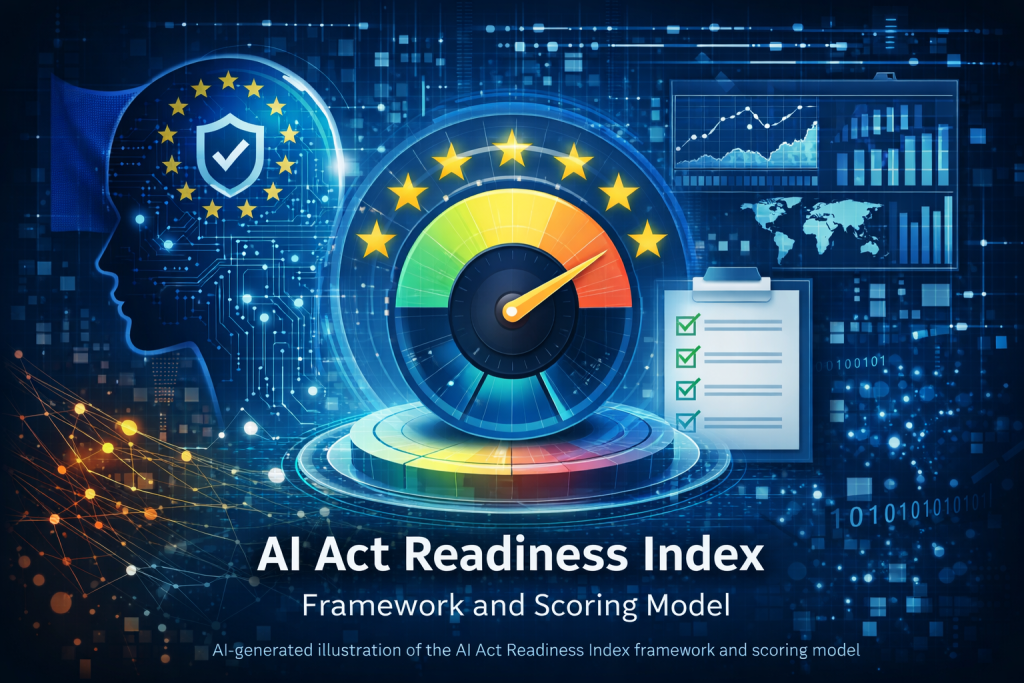
AI-generated illustration of AI Act Readiness Index scoring methodology and analysis

The EU AI Act Enforcement Gap: Which Countries Are Ready for the AI Act

This analysis reflects the state of EU AI Act enforcement readiness as of 1 April 2026, based on the first edition of the index. The index has since been updated (May 2026) to reflect new designations, legislative developments, and the Digital Omnibus agreement of 7 May 2026, which pushes the high-risk enforcement deadline from August

The EU AI Act Enforcement Gap: Which Countries Are Ready for the AI Act Read More »

Office workers attending an AI literacy training session with an EU regulatory framework displayed on screen

The Weight of AI Literacy in the EU AI Act: What Is Expected from Companies — and What Can They Actually Deliver?

When the EU AI Act entered into force in August 2024, most compliance attention immediately gravitated toward its high-risk provisions: the risk classifications, the conformity assessments, the technical documentation requirements. Article 4, tucked near the beginning of the regulation, attracted far less scrutiny. It is, after all, just one sentence long. That sentence, however, has

The Weight of AI Literacy in the EU AI Act: What Is Expected from Companies — and What Can They Actually Deliver? Read More »

AI governance concept with glowing neural network node surrounded by EU-style regulatory stars and silhouettes of SMEs and public institutions

The EU AI Act’s Innovation Chapter: Sandboxes, SMEs, and the Limits of Open Source

Chapter VI of the EU AI Act is where Brussels attempts something unusual for a regulatory text — it tries to be helpful. What it reveals about the law’s architecture, its blind spots, and its real-world friction is worth examining carefully. The EU AI Act is, by design, a demanding piece of legislation. It classifies

The EU AI Act’s Innovation Chapter: Sandboxes, SMEs, and the Limits of Open Source Read More »