Updated May 2026 to reflect the Digital Omnibus agreement of 7 May 2026, which pushes the AI Act high-risk enforcement deadline from August 2026 to December 2027.
Artificial intelligence is rapidly transforming industries, from logistics and finance to healthcare and manufacturing. To address the risks and opportunities created by these technologies, the European Union has adopted the EU AI Act, the world’s first comprehensive legal framework regulating artificial intelligence.
The EU AI Act introduces a risk-based approach to AI regulation, meaning that the obligations placed on companies depend on the level of risk an AI system poses to individuals and society.
For businesses operating in Europe, understanding the structure and scope of the AI Act is becoming essential. This guide explains what the regulation is, why it was created, how the risk classification system works, which companies it affects, and when the rules will apply.
Download your free AI Act Compliance Tracker for SMEs.
See the AI Act Compliance Tracker for SMEs here to learn what it does.
What Is the EU AI Act?
The EU AI Act is a regulation that establishes a legal framework governing the development, deployment, and use of artificial intelligence systems within the European market.
Its objectives include:
• Ensuring AI systems used in the EU are safe and trustworthy
• Protecting fundamental rights and democratic values
• Providing legal certainty for businesses
• Supporting innovation in artificial intelligence
Unlike traditional technology regulations, the AI Act does not regulate AI as a single category. Instead, it introduces a risk-based classification system, where stricter rules apply to systems with greater potential to harm individuals or society.
The regulation applies to companies both inside and outside the EU if their AI systems are used in the European market.
Why the EU Created the AI Act
Artificial intelligence is increasingly used in decision-making processes that affect people’s lives.
Examples include:
• Hiring and recruitment tools
• Credit scoring systems
• Medical diagnostic systems
• Border control technologies
• Educational evaluation tools
These applications raise concerns about bias, discrimination, transparency, and safety.
The EU AI Act was created to address these risks while still encouraging innovation. The regulation reflects the EU’s broader strategy of promoting “trustworthy AI” — artificial intelligence that respects human rights, democratic values, and the rule of law.
The AI Act also aims to create a single regulatory framework across the EU, preventing fragmented national rules and providing clarity for businesses.
The Risk-Based Structure of the EU AI Act
The core concept of the regulation is a four-tier risk classification system.
AI systems are categorized according to their potential impact on people and society.
The four categories are:
- Unacceptable risk
- High risk
- Limited risk
- Minimal risk
Each category comes with different legal obligations.
Unacceptable Risk AI Systems
AI systems classified as unacceptable risk are prohibited entirely within the EU.
These systems are considered fundamentally incompatible with European values and fundamental rights.
Examples include:
• AI systems that manipulate human behavior in harmful ways
• Social scoring systems used by governments
• Certain forms of real-time biometric identification in public spaces
• AI systems exploiting vulnerabilities of children or vulnerable groups
Because of their potential impact on civil liberties, these applications are banned outright under the AI Act.
Companies developing or deploying such systems would face significant regulatory penalties.
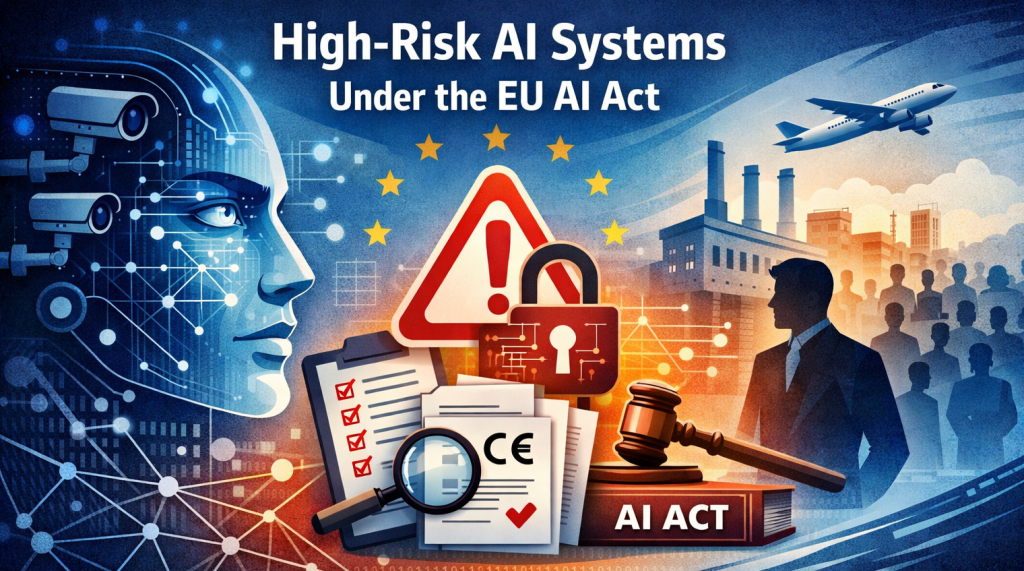
High-Risk AI Systems
The high-risk category forms the central pillar of the EU AI Act.
These systems are not banned but are subject to strict regulatory requirements before they can be placed on the EU market.
High-risk AI systems include those used in areas such as:
• Critical infrastructure
• Healthcare and medical devices
• Education and exam evaluation
• Employment and recruitment
• Law enforcement
• Migration and border management
• Access to essential services such as credit
Companies developing or deploying high-risk AI systems must meet several obligations, including:
• Risk management systems
• High-quality training data
• Technical documentation
• Human oversight mechanisms
• Transparency obligations
• Post-market monitoring
In many cases, these systems must undergo conformity assessments before they can be deployed.
You can explore these obligations in more detail in our guide to high-risk AI systems under the EU AI Act.
Limited Risk AI Systems
AI systems classified as limited risk are subject primarily to transparency obligations.
The main requirement is that users must be informed when they are interacting with AI.
Examples include:
• Chatbots used in customer service
• AI-generated content
• Deepfake technologies
Under the AI Act, companies must ensure that individuals are clearly informed that the content or interaction is generated by AI.
The goal is to prevent deception and improve transparency in digital environments.
Minimal Risk AI Systems
Most AI applications fall into the minimal risk category.
These systems pose little or no risk to individuals and therefore face very limited regulatory obligations.
Examples include:
• AI spam filters
• Video game AI systems
• AI used for inventory forecasting
• Recommendation algorithms
The EU intentionally keeps regulation light in this category to encourage innovation and technological development.
Download your free AI Act Compliance Tracker for SMEs.
See the AI Act Compliance Tracker for SMEs here to learn what it does.
Which Companies the EU AI Act Affects
The AI Act has a broad scope and applies to multiple actors within the AI ecosystem.
These include:
AI Providers
Companies that develop AI systems and place them on the EU market under their own name or brand.
Providers carry most of the compliance obligations under the regulation.
AI Deployers
Organizations that use AI systems within their operations.
Examples include:
• Banks using AI for credit scoring
• Logistics companies optimizing routes with AI
• Retail companies using AI analytics
Deployers must ensure AI systems are used in accordance with the regulation.
Importers and Distributors
Companies that import or distribute AI systems in the EU market must ensure the products they sell comply with the regulation.
Non-EU Companies
The AI Act also applies to companies located outside the EU if their AI systems are used within the European market.
This extraterritorial reach means the regulation will affect global technology companies and startups, not only European firms.
EU AI Act Timeline: When the Rules Apply
The implementation of the EU AI Act will take place gradually.
2024
The regulation is formally adopted and enters into force.
2025
Provisions banning unacceptable-risk AI systems begin to apply.
December 2027
The most important milestone for businesses: compliance obligations for high-risk AI systems begin to apply.
2027 and Beyond
Additional provisions related to governance mechanisms and advanced AI models continue to take effect.
Why Companies Should Start Preparing Now
Even though some obligations will apply later, businesses should begin preparing early.
Preparation may include:
• Mapping AI systems used within the organization
• Identifying risk categories under the AI Act
• Implementing governance and compliance frameworks
• Developing documentation and monitoring systems
Companies that start early will be better positioned to navigate the regulatory landscape and avoid costly compliance gaps.
A New Era of AI Governance in Europe
The EU AI Act represents a major shift in how artificial intelligence is regulated globally.
By introducing a risk-based framework, the regulation seeks to balance innovation with safety and fundamental rights.
For companies operating in Europe, understanding the structure, scope, and risk classification of the AI Act is the first step toward compliance. As implementation progresses toward 2026, organizations that proactively adapt to the new regulatory environment will be best positioned to succeed in the emerging era of AI governance and regulatory intelligence.